
In my last post, I shared 3 tips to help you navigate what to do when your dog struggles with all the things:
- Management as much as possible
- Pick one thing to work on, maybe 2
- Don’t skip the foundations (the basics).
Last time we got into the details with management. Today, let’s talk about the second one today: pick 1-2 things to work on at a time.
Now before you roll your eyes and check out, stay with me a minute. 🙏🏻
Because I know you’ve heard this advice before. I know it feels vague or even generic.
So let’s really get into it! By the end, I hope I’ve at least made you think or given you a new perspective.
Why only 1-2 things at a time?!
I know you’ve got big plans and dreams with your dog. You want to:
-Walk around your neighborhood 🦮
-Do some training so you can trim nails without a meltdown 💅🏼
-Work on car rides so you can go fun places together 🚙
-Introduce your dog to your family and friends 🐶
I know you want to address all the things.
But this is a fast-track to burnout. Please trust me on this. It’s not a fun place to be. I don’t want that for you.
Choosing 1-2 things to address at a time will allow you to track progress more easily. And I cannot stress the importance of tracking progress enough.
There are only so many hours in the day my friend. While most of the sessions I recommend are less than 5 minutes, actually doing the thing consistently over weeks and months is another story. Executive functioning issues, anyone?

Let’s do some dog training math. My general recommendation is 1-3 training sessions a day, about 2-5 minutes each. So that’s anywhere from 2 to 15 minutes a day.
But if you are working on more than one thing at a time, you will need to add in enough training sessions to really see progress. And you will need to plan sessions and record progress for all these sessions to make sure you’re not wasting your efforts.
It’s not sustainable for you or your dog. Don’t do that to yourself, friend.
Ok, hopefully I’ve convinced you not to overdo it.
Now, how do you pick those 1-2 things to work on???
How to pick where to start
When you feel like you’re drowning, the “pick one thing to focus on!” advice hardly feels like a life raft. Your dog is barking at everything. The barking needs to stop or cut down. By a lot. As my niece said when she was a toddler learning manners, “right now, please.”
Deep breath.
If you missed the management post, click here. That’s a critical first step. Don’t skip it!
Once your management phase has allowed you some time to breathe, let’s talk about how to pick what to address first. Here are some questions to ask yourself:
- What triggers (like dogs, sounds, or people) cannot be avoided?
- What triggers are easiest to avoid?
- What is a commonly occurring/predictable trigger? (The same house with a barky dog, the doorbell, etc.)
- What management are you comfortable with using indefinitely?
- Which of your dog’s triggers is most stressful for you? What would give you the most relief?
- What is most important to you?
I’ll use my dog Mara to show you how I worked through this for us. There is no right answer. But you ideally should start with what’s going to get you the most bang for your buck.

On Mara’s punch list (circa May 2023): potty training, leash reactivity, prey drive (which resulted in not great leash walking), noise reactivity, barrier frustration (barking at things when she was behind a gate), stranger-danger/hyperactivity around people, body handling (she hated all grooming from baths, nail filings, brushing, ear care), and she was hyper in the car, constantly whining and pacing.
Whew.
While I felt better-equipped thanks to the lessons I learned with Rosie, it was still a lot.
The first thing we had to work on with Mara was potty training. Because that was the most stressful and disruptive thing for me. I just could not handle cleaning up pee all the time. Yuck.
But here’s the catch.
Our house doesn’t have any grass. So we have to take Mara out for walks to the field near our house several times a day.
Her prey drive meant she was on alert and pulling on the leash the second we were out the door.
But when she saw another dog, it was a full-blown explosion of lunging and barking. She was a fury at the end of the leash.
Mara’s sharp, punctuated barks seemed to echo off every house in our neighborhood. Once, a neighbor actually came out on his porch once to see what the commotion was.
Ok, bam. I had my first two issues to address: potty training and potty breaks without a bark-polsion.
Then we got creative with her other triggers:
- Her stranger-danger wasn’t a priority because we rarely had people over. If we did have someone over, I asked them to text when they arrived instead of ringing the bell. Then I could prepare and avoid a lot of reactive behavior.
- We started using a scratchboard since she hated getting her nails filed.
- A white noise playlist did wonders for her noise reactivity.
But I could not avoid taking her out for walks. And because of the frequency of the walks, it was really hard not to run into other dogs.
Our goal was to avoid this bark-polsion at all costs.
Now, there were a lot of different ways I could do this. And by that broad goal, success can look like a lot of different things.
I know you’ve heard of SMART goals. I promise this isn’t going to turn into a corporate presentation. But you need to be very clear on what success looks like. Paint a picture. Someone should be able to clearly imagine what is going on by your description.
And…
You need to be flexible with your definition of success: You get to decide what “good enough” is and you’re allowed to change it. Let me explain. ⬇️
Avoiding bark-polsion to you may mean you and your dog walk by another dog without you having to do anything.
Or, maybe once you start training you realize what a gigantic ask that is for your dog. You decide that feeding your dog beef jerky non-stop around another dog is good enough, thank you very much.
That’s me and Mara.
Thanks to the lessons I learned with Rosie, I created the Ten to Zen. It’s my signature protocol to treat your dog’s reactivity. The cool thing about it is you don’t have to get to step 10 to stop reactions and get peaceful potty walks.
Any of the ten steps should give you success and it gives you the flexibility to progress at your and your dog’s pace.
I could work all the way to step 9 or 10 (no human intervention, showing curiosity) with Mara. But right now, step 2 (counterconditioning) is working really well for us.
In fact, it’s going so well for us, we are actually taking longer, just-for-fun neighborhood walks now!
Our next mini-goal on the leash is for her to stop staring at another dog when I call her name. But for now, walks are exponentially better and I’m not putting too much pressure on us.
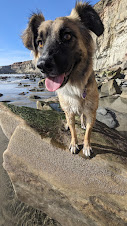
And we’ve since moved on to the next training topic: toenails.
Leave me a comment because trainers love positive reinforcement too! What are you working on with your dog right now?
Part 3 coming soon – skip the foundations and falter later.
Here for you,
Andrea
 Best Life Dog Training Blog
Leave a comment