Welcome back for the third and final installment of where to even start with your reactive dog. I hope part 1 and part 2 brought you some peace and clarity. And I know to many of you it may seem like basic stuff and it can be easily overlooked. But I wouldn’t write a 3-part series about it if it didn’t matter. I’m looking out for you, friend.
OK, let’s say you’ve identified your 1 (maybe 2) things to work on. You’ve got management in place for everything else. You’re ready to get to work!
Maybe you’re like me and Mara and want to get calmer walks first. You watched that one video on YouTube and it looked so easy!
So you clip on the leash and head out for a walk to get to work.
Ok, here comes another dog. Wait…what are you supposed to do? Your stomach drops and your grip tightens. You hear that low growl from your dog and know a barking frenzy is only mili-seconds away.
It feels like you’re moving through quicksand. Your hands fumble to get treats, the leash gets tangled, you almost trip trying to run in the other direction.
Back home, you feel defeated. Now what? Where do you go from here?
Friend, I know calmer walks are what you want. But you gotta lay some solid foundations first.
And spoiler alert: regardless of what you want to work on with your dog, it starts at home.
Something else: these foundations aren’t just for your dog. They are for you too.
First, let’s talk about 2 foundations for your dog.
#1 Relaxation/self-regulation
Your dog needs to learn how to relax. Relaxing, or self-regulation is a skill that can be taught and ideally, practiced often. I will die on this hill.

Your dog needs to know how to self-regulate so they can keep their cool when that doodle across the street barks at them as they walk by. (No disrespect to doodles.)
You want your dog to be nonchalant as you stroll by that other dog across the street. That nonchalant attitude can be practiced and improved, just like anything else you teach your dog.
Fearful dogs learn that lunging and barking just isn’t necessary. And most of the time, it doesn’t have any impact anyway so they might as well just chill.
For super excited dogs, they learn how to self-regulate when they get those big feelings. Which allows them to learn new, more appropriate ways to behave and possibly engage with things in their environment.
It starts really basic. Get a towel, a mat, a dog bed, doesn’t matter. Pick a spot to put it. Anytime your dog is resting on it, calmly and quietly drop a treat near their nose and walk away. If they don’t lay on the spot, keep periodically dropping treats there until they figure out that’s the magic spot.
It may look like nothing is happening. But observe your dog’s body language as you continue this exercise. Are they faster to lay down on the spot? Is their laying down position less of a sphinx and more lazy, rolling on to their hips? Are their eyes more relaxed? Their eyes are soft?
This is the foundation we are looking for: relaxing is rewarding. Your dog needs to be able to do this at home before trying to get it outside in the real world.
Second foundational skill for your dog: they need to have a charged marker.
I know that’s a little dog lingo-y so let me explain. A marker is a notation (usually a single word or short sound) that lets your dog know they are doing something you like.
Charging it means you’re giving the marker word its magic: you are pairing it with a tasty treat so your dog knows that “yes!” or “good!” or a click from a clicker is going to yield a delicious bite of chicken.
That’s it. These two things are going to make life SO much easier for your dog later on.
But, let’s talk about you for a second, my friend.
I have talked a lot about body language in the past. You NEED to be really good at reading your dog’s body language. I know seeing it and recognizing it for what it is can be super uncomfortable, but your relationship with your dog will improve.
But you also need good timing and mechanics.
With timing, I am referring to the timing of that marker and the reward. The timing of this simple chain is important: mark then the reward. Often, dog parents get flustered and they reverse this order. Or they do them at the same time and the mark is lost on the dog (meaning they aren’t learning and making the connections you want them to).
Practice simply giving your marker work, reaching in your treat pouch for the reward and then delivering it to your dog. I recommend you record yourself so you can review your timing and the other important skill for you:
Your mechanics.
When I say “mechanics” I’m really talking about your dexterity, motor skills, and muscle memory.
Good mechanics for you looks like:
- Not a lot of excessive body movement
- Fluidity in which you can reach into your treat pouch to deliver a reward
- Consistency in your behavior
- Avoiding problematic habits
- Ease of handling the leash around triggers
- No change in the above mentioned when the criteria is increased
Team Elliott has been working on learning better options when seeing another dog (i.e. something to do that’s not lunging and barking).
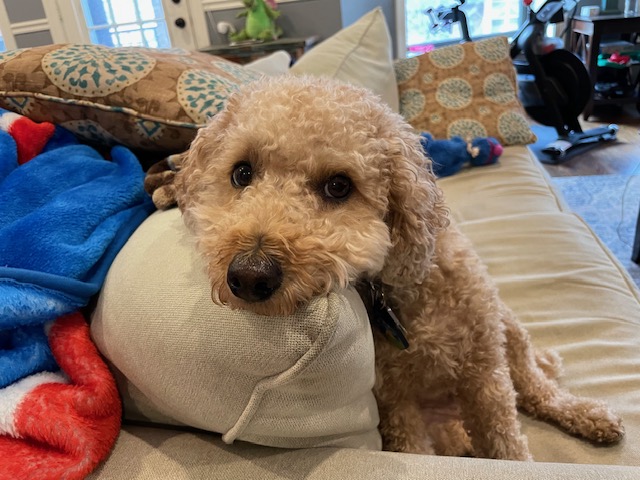
Their plan for training that week was to have Elliott move in a different direction after he spotted another dog and then give him a treat. Sounds simple enough.
But when they reported back the next week, Elliott’s mom told me that she got flustered and totally forgot what to do.
If that’s you, don’t feel bad. This is actually quite normal. Remember, you are learning new skills too! And I know for many of you, your dog’s triggers are just as anxiety-inducing for you.
And science tells us, that dexterity, information processing, ability to learn new things….all that goes down when fear, anxiety, and/or stress go up.
So what did we do for Elliott’s humans? The same thing you do for your dog. Lowered the criteria. We brainstormed easier training setups so they could get more practice in.
On graduation day, they were celebrating that he is calmer and happier on walks with less frantic pulling and he’s engaging with his humans and his humans are now in presence of some other dogs at an acceptable distance.
Pretty cool considering Elliott rarely would even eat treats outside of his driveway.
Foundations really are that important! If you feel stuck with your dog, ask yourself if you overlooked critical, early steps.
How did this post land with you? Are you reflecting on a specific foundational skill you or your dog need to practice a bit more?
Tell me in the comments!
Here for you,
Andrea
P.S. Want help to get your dog from reactive to relaxed? My signature Calm Canine Program does just that! Click here to learn more and book a free Q&A call with me!
 Best Life Dog Training Blog
Leave a comment