-
Where to start with your reactive dog – part 3 of 3
Welcome back for the third and final installment of where to even start with your reactive dog. I hope part 1 and part 2 brought you some peace and clarity. And I know to many of you it may seem like basic stuff and it can be easily overlooked. But I wouldn’t write a 3-part series about it if it didn’t matter. I’m looking out for you, friend.
OK, let’s say you’ve identified your 1 (maybe 2) things to work on. You’ve got management in place for everything else. You’re ready to get to work!
Maybe you’re like me and Mara and want to get calmer walks first. You watched that one video on YouTube and it looked so easy!
So you clip on the leash and head out for a walk to get to work.
Ok, here comes another dog. Wait…what are you supposed to do? Your stomach drops and your grip tightens. You hear that low growl from your dog and know a barking frenzy is only mili-seconds away.
It feels like you’re moving through quicksand. Your hands fumble to get treats, the leash gets tangled, you almost trip trying to run in the other direction.
Back home, you feel defeated. Now what? Where do you go from here?
Friend, I know calmer walks are what you want. But you gotta lay some solid foundations first.
And spoiler alert: regardless of what you want to work on with your dog, it starts at home.
Something else: these foundations aren’t just for your dog. They are for you too.
First, let’s talk about 2 foundations for your dog.
#1 Relaxation/self-regulation
Your dog needs to learn how to relax. Relaxing, or self-regulation is a skill that can be taught and ideally, practiced often. I will die on this hill.

Your dog needs to know how to self-regulate so they can keep their cool when that doodle across the street barks at them as they walk by. (No disrespect to doodles.)
You want your dog to be nonchalant as you stroll by that other dog across the street. That nonchalant attitude can be practiced and improved, just like anything else you teach your dog.
Fearful dogs learn that lunging and barking just isn’t necessary. And most of the time, it doesn’t have any impact anyway so they might as well just chill.
For super excited dogs, they learn how to self-regulate when they get those big feelings. Which allows them to learn new, more appropriate ways to behave and possibly engage with things in their environment.
It starts really basic. Get a towel, a mat, a dog bed, doesn’t matter. Pick a spot to put it. Anytime your dog is resting on it, calmly and quietly drop a treat near their nose and walk away. If they don’t lay on the spot, keep periodically dropping treats there until they figure out that’s the magic spot.
It may look like nothing is happening. But observe your dog’s body language as you continue this exercise. Are they faster to lay down on the spot? Is their laying down position less of a sphinx and more lazy, rolling on to their hips? Are their eyes more relaxed? Their eyes are soft?
This is the foundation we are looking for: relaxing is rewarding. Your dog needs to be able to do this at home before trying to get it outside in the real world.
Second foundational skill for your dog: they need to have a charged marker.
I know that’s a little dog lingo-y so let me explain. A marker is a notation (usually a single word or short sound) that lets your dog know they are doing something you like.
Charging it means you’re giving the marker word its magic: you are pairing it with a tasty treat so your dog knows that “yes!” or “good!” or a click from a clicker is going to yield a delicious bite of chicken.
That’s it. These two things are going to make life SO much easier for your dog later on.
But, let’s talk about you for a second, my friend.
I have talked a lot about body language in the past. You NEED to be really good at reading your dog’s body language. I know seeing it and recognizing it for what it is can be super uncomfortable, but your relationship with your dog will improve.
But you also need good timing and mechanics.
With timing, I am referring to the timing of that marker and the reward. The timing of this simple chain is important: mark then the reward. Often, dog parents get flustered and they reverse this order. Or they do them at the same time and the mark is lost on the dog (meaning they aren’t learning and making the connections you want them to).
Practice simply giving your marker work, reaching in your treat pouch for the reward and then delivering it to your dog. I recommend you record yourself so you can review your timing and the other important skill for you:
Your mechanics.
When I say “mechanics” I’m really talking about your dexterity, motor skills, and muscle memory.
Good mechanics for you looks like:
- Not a lot of excessive body movement
- Fluidity in which you can reach into your treat pouch to deliver a reward
- Consistency in your behavior
- Avoiding problematic habits
- Ease of handling the leash around triggers
- No change in the above mentioned when the criteria is increased
Team Elliott has been working on learning better options when seeing another dog (i.e. something to do that’s not lunging and barking).

Their plan for training that week was to have Elliott move in a different direction after he spotted another dog and then give him a treat. Sounds simple enough.
But when they reported back the next week, Elliott’s mom told me that she got flustered and totally forgot what to do.
If that’s you, don’t feel bad. This is actually quite normal. Remember, you are learning new skills too! And I know for many of you, your dog’s triggers are just as anxiety-inducing for you.
And science tells us, that dexterity, information processing, ability to learn new things….all that goes down when fear, anxiety, and/or stress go up.
So what did we do for Elliott’s humans? The same thing you do for your dog. Lowered the criteria. We brainstormed easier training setups so they could get more practice in.
On graduation day, they were celebrating that he is calmer and happier on walks with less frantic pulling and he’s engaging with his humans and his humans are now in presence of some other dogs at an acceptable distance.
Pretty cool considering Elliott rarely would even eat treats outside of his driveway.
Foundations really are that important! If you feel stuck with your dog, ask yourself if you overlooked critical, early steps.
How did this post land with you? Are you reflecting on a specific foundational skill you or your dog need to practice a bit more?
Tell me in the comments!
Here for you,
Andrea
P.S. Want help to get your dog from reactive to relaxed? My signature Calm Canine Program does just that! Click here to learn more and book a free Q&A call with me!
-
Where to start with your reactive dog – part 2 of 3
In my last post, I shared 3 tips to help you navigate what to do when your dog struggles with all the things:
- Management as much as possible
- Pick one thing to work on, maybe 2
- Don’t skip the foundations (the basics).
Last time we got into the details with management. Today, let’s talk about the second one today: pick 1-2 things to work on at a time.
Now before you roll your eyes and check out, stay with me a minute. 🙏🏻
Because I know you’ve heard this advice before. I know it feels vague or even generic.
So let’s really get into it! By the end, I hope I’ve at least made you think or given you a new perspective.
Why only 1-2 things at a time?!
I know you’ve got big plans and dreams with your dog. You want to:
-Walk around your neighborhood 🦮
-Do some training so you can trim nails without a meltdown 💅🏼
-Work on car rides so you can go fun places together 🚙
-Introduce your dog to your family and friends 🐶I know you want to address all the things.
But this is a fast-track to burnout. Please trust me on this. It’s not a fun place to be. I don’t want that for you.
Choosing 1-2 things to address at a time will allow you to track progress more easily. And I cannot stress the importance of tracking progress enough.
There are only so many hours in the day my friend. While most of the sessions I recommend are less than 5 minutes, actually doing the thing consistently over weeks and months is another story. Executive functioning issues, anyone?

Let’s do some dog training math. My general recommendation is 1-3 training sessions a day, about 2-5 minutes each. So that’s anywhere from 2 to 15 minutes a day.
But if you are working on more than one thing at a time, you will need to add in enough training sessions to really see progress. And you will need to plan sessions and record progress for all these sessions to make sure you’re not wasting your efforts.
It’s not sustainable for you or your dog. Don’t do that to yourself, friend.
Ok, hopefully I’ve convinced you not to overdo it.
Now, how do you pick those 1-2 things to work on???
How to pick where to start
When you feel like you’re drowning, the “pick one thing to focus on!” advice hardly feels like a life raft. Your dog is barking at everything. The barking needs to stop or cut down. By a lot. As my niece said when she was a toddler learning manners, “right now, please.”
Deep breath.
If you missed the management post, click here. That’s a critical first step. Don’t skip it!
Once your management phase has allowed you some time to breathe, let’s talk about how to pick what to address first. Here are some questions to ask yourself:
- What triggers (like dogs, sounds, or people) cannot be avoided?
- What triggers are easiest to avoid?
- What is a commonly occurring/predictable trigger? (The same house with a barky dog, the doorbell, etc.)
- What management are you comfortable with using indefinitely?
- Which of your dog’s triggers is most stressful for you? What would give you the most relief?
- What is most important to you?
I’ll use my dog Mara to show you how I worked through this for us. There is no right answer. But you ideally should start with what’s going to get you the most bang for your buck.

On Mara’s punch list (circa May 2023): potty training, leash reactivity, prey drive (which resulted in not great leash walking), noise reactivity, barrier frustration (barking at things when she was behind a gate), stranger-danger/hyperactivity around people, body handling (she hated all grooming from baths, nail filings, brushing, ear care), and she was hyper in the car, constantly whining and pacing.
Whew.
While I felt better-equipped thanks to the lessons I learned with Rosie, it was still a lot.
The first thing we had to work on with Mara was potty training. Because that was the most stressful and disruptive thing for me. I just could not handle cleaning up pee all the time. Yuck.
But here’s the catch.
Our house doesn’t have any grass. So we have to take Mara out for walks to the field near our house several times a day.
Her prey drive meant she was on alert and pulling on the leash the second we were out the door.
But when she saw another dog, it was a full-blown explosion of lunging and barking. She was a fury at the end of the leash.
Mara’s sharp, punctuated barks seemed to echo off every house in our neighborhood. Once, a neighbor actually came out on his porch once to see what the commotion was.
Ok, bam. I had my first two issues to address: potty training and potty breaks without a bark-polsion.
Then we got creative with her other triggers:
- Her stranger-danger wasn’t a priority because we rarely had people over. If we did have someone over, I asked them to text when they arrived instead of ringing the bell. Then I could prepare and avoid a lot of reactive behavior.
- We started using a scratchboard since she hated getting her nails filed.
- A white noise playlist did wonders for her noise reactivity.
But I could not avoid taking her out for walks. And because of the frequency of the walks, it was really hard not to run into other dogs.
Our goal was to avoid this bark-polsion at all costs.
Now, there were a lot of different ways I could do this. And by that broad goal, success can look like a lot of different things.
I know you’ve heard of SMART goals. I promise this isn’t going to turn into a corporate presentation. But you need to be very clear on what success looks like. Paint a picture. Someone should be able to clearly imagine what is going on by your description.
And…
You need to be flexible with your definition of success: You get to decide what “good enough” is and you’re allowed to change it. Let me explain. ⬇️
Avoiding bark-polsion to you may mean you and your dog walk by another dog without you having to do anything.
Or, maybe once you start training you realize what a gigantic ask that is for your dog. You decide that feeding your dog beef jerky non-stop around another dog is good enough, thank you very much.
That’s me and Mara.
Thanks to the lessons I learned with Rosie, I created the Ten to Zen. It’s my signature protocol to treat your dog’s reactivity. The cool thing about it is you don’t have to get to step 10 to stop reactions and get peaceful potty walks.
Any of the ten steps should give you success and it gives you the flexibility to progress at your and your dog’s pace.
I could work all the way to step 9 or 10 (no human intervention, showing curiosity) with Mara. But right now, step 2 (counterconditioning) is working really well for us.
In fact, it’s going so well for us, we are actually taking longer, just-for-fun neighborhood walks now!
Our next mini-goal on the leash is for her to stop staring at another dog when I call her name. But for now, walks are exponentially better and I’m not putting too much pressure on us.
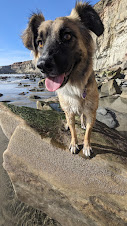
And we’ve since moved on to the next training topic: toenails.
Leave me a comment because trainers love positive reinforcement too! What are you working on with your dog right now?
Part 3 coming soon – skip the foundations and falter later.
Here for you,
Andrea
-
Where to start with your reactive dog
Does your photo app ever send you down a memory lane rabbit hole? Google Photos did this to me over the weekend.
Six years ago this month, Matt and I took Maggie and Tres on a road trip up to Big Sur. We split our time between a hotel by the beach and a cabin in the woods. We picked lodging with them in mind and made arrangements at a local day boarding when we couldn’t take them with us. But aside from that, we didn’t give a second thought to taking them on this adventure with us. We were having a great time and so were our dogs, what could be better!
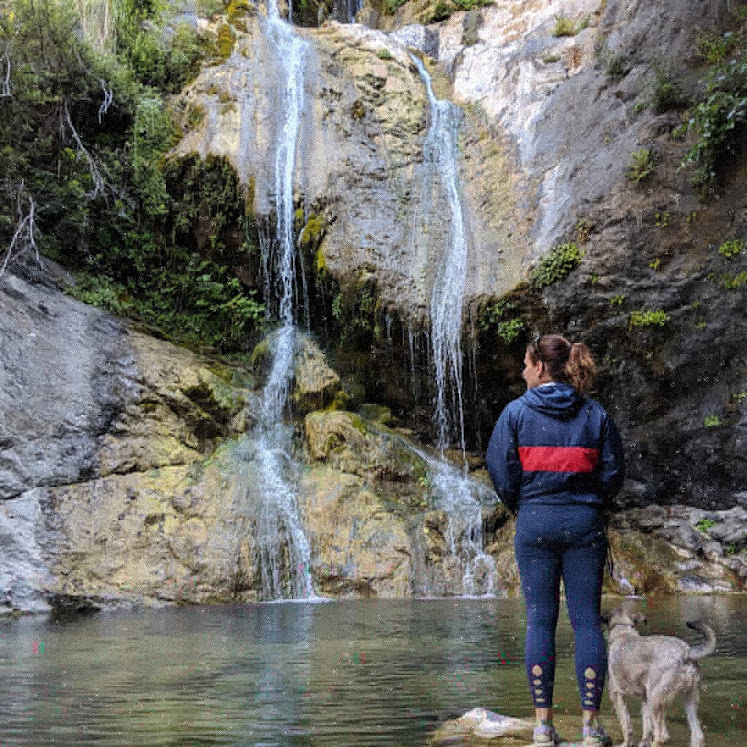
On a dog-friendly trail with Tres 
Maggie 😇 enjoying the Big Sur view Fast-forward to April 2020. I adopted Rosie. I knew she was high-energy and had some “bite-inhibition issues.” But I didn’t know she was terrified of other dogs on walks. I didn’t know she would try to scale our fence every time she heard a noise on the other side. I didn’t know she would bark incessantly at anyone that came into our home.
Forget road trips. We couldn’t even get around the block.
I know when you adopted your dog you weren’t thinking, “I hope they hate seeing other dogs on walks! I hope they bark at everything when we go out together! Those will be fun and challenging things to work on together!”
Leash reactivity, stranger-danger, noise reactivity, car anxiety (or over-excitedness in the car), squirrel/bunny chasing…these are some of the most common issues I help dog parents with.
But what happens when you have a dog that has all of the above???
Here are 3 tips to help get you started. They are the lessons I learned from Rosie. When we rescued Mara in May 2023, I applied these 3 principles with her and prevented myself from spinning my wheels and getting burned out and overwhelmed.
When you don’t know where to start, start with these 3 things:
- Use management as much as possible
- Focus on one thing at a time (two at the MOST)
- Don’t skip the foundations
I have a lot to say about each of these things. In this post, we’re going to dive into management.
Management just means you are preventing the undesirable behavior (lunging at dogs, barking out the window, jumping on guests, etc.) from happening – no training required.
The goal of management is to immediately reduce stress for you and your dog.
Baby gates, ex-pens, white noise playlists, leashes, window film are just a few management options, depending on what you’re dealing with:
- A dog behind a baby gate can’t run through an open door.
- A leash prevents your dog from jumping on guests
- A white noise playlist buffers outsides sounds, allowing your dog to rest
- Window films blocks your dog’s view from seeing people outside
- Early morning walks means your less likely to run into other people/dogs
I think dog parents feel lazy by using management. And to that I say, work smarter, not harder.
Friends, not everything needs to be “trained.” Sometimes, you can use management forever. And there is absolutely nothing wrong with this.
When we rescued Mara in May of 2023, management was heavily used. She was not house trained. If my husband or I couldn’t watch her, that meant she was confined to a space area.
She really liked napping on the bed in my office but would explode into a barking frenzy if she heard a noise outside. Car door slams, diesel engines, barking dogs, people talking…it all set her off. However, if I played soft music or white noise, it buffered it just enough to help her relax more.
If you have a dog that has so many struggles, I recommend using management as much as possible at first. It’s so important to prevent your dog from rehearsing this undesirable behavior pattern, yes.
But when you have a dog with so many triggers, it can mean your dog is under high levels of chronic stress.
Chronic stress is the worst kind of stress. It can impact physical health and well-being in your dog. So by all means, use management to reduce these stressful reactions for your dog. It will benefit you too.
A lot of dog parents tell me they feel like their dog’s world is small when using management. You aren’t taking your dog out much, you’re avoiding walks at popular times, you aren’t taking your dog places.
But important things are happening. Think of it as providing decompression. If your dog has had a rough go, rest and recovery are vital. It’s like a reset.
Now, if you are eager to get to work, don’t think of this management/decompression period as a waste. This is also a great time to start planning your training approach and laying good foundations. Which I’ll talk about next time!
What management are you using with your dog? What are you going to start using with your dog?
Here for you,
Andrea
-
When regressions happen with your reactive dog
I almost passed out. It was a good thing I was already sitting down, otherwise I would have been on the floor. My vision went, my heart was racing, and I started sweating. I knew I needed to get OUT of that room.
What on Earth triggered such a reaction in me?
A simple blood draw earlier this week.
Stay with me, I promise I’m going to make this about dogs.
If you’ve been here a while, you’ve heard me talk about how squeamish I am with medical stuff. I really put my mom through it when I had to go to the doctor. It wasn’t until my mid-20s that I got somewhat of a handle on it: I would actually make the appointment and go. I didn’t love it, but I had strategies in place that helped me cope with it.
I hadn’t gotten light-headed in YEARS. I tolerated blood draws and injections like a champ (well, relative to 5-23 year old Andrea).
I told my husband, Matt, how embarrassed I was. I mean, they had to get me water and cold paper towels. “I really thought I had passed this point.” He said, in a loving way as a man who knows me well, “You didn’t sleep well last night. You’re never good after a night of not enough sleep. And you are fasting.”
Basically, I am like a child when I haven’t slept or eaten.
I relayed this experience to my friend, as if trying to offload some of my embarrassment. She said, “You’re not operating on an A+ system. Stacked deck. Perfect storm.”
Thinking back, the phlebotomist called me back into the room and I had to wait several minutes before it began. I even had to pay while I was sitting in the chair next to all the supplies (that I try so hard to avoid looking at). Being in that little room is the peak of stress for me, the less time in there the better.
Once my breathing and heart rate stopped, I reflected. And it got me thinking about dogs. (I told you I was going to tie this together).
3 things come to mind here:
- Realistic expectations
- Trigger stacking
- Regressions
Let’s dive in!
#1 – Realistic expectations
When I first started working with reactive dogs, I think I subconsciously had this mindset of helping the dog go from negative feelings to positive ones. I mean, that’s why counterconditioning exists.
But is this realistic?
I am never, ever going to be the person who is easy-breezy about going to the doctor. It will always make me a little uneasy, I will never look forward to it. However, I can do things that help me get through it without scaring the bejesus out of the medical stuff.
My dog, Rosie, is part herding dog. Her genetics make it her instinct to charge up and try to herd something that suddenly appears in her environment. She’s never going to be the type of dog that loves strangers. She’s not going to be crazy about other people in her house. But we do have strategies that make it less stressful for her.
#2 – Trigger stacking
For me, it was the lack of sleep and food. And then I had to wait in the little room longer. And the second before she started, she told me she was taking FOUR vials instead of just one. That was the straw. My sympathetic nervous system was already heightened. And the strategies I had in place to cope weren’t enough by the time I got to a certain threshold.
Sound familiar?
A pattern I’ve noticed for Northern Hemisphere dogs is that this time of year as the weather gets nicer, regressions can happen. My hypothesis is that more people are out and about causing more stress for reactive dogs. Changes in weather conditions can also be stressful for some dogs. Rosie is not a fan of windy days.
Note that the triggers might not always be obvious to you. For example, in our neighborhood there are several short-term vacation rentals. In the spring and summer, they are booked up more consistently which means there are more cars parked on the street. It took me several walks with Rosie for me to figure out what was stressing her out. The people/dogs didn’t even have to be out – the extra cars on the street were triggering enough to have her more on edge.
If you feel your dog is being trigger stacked, read until the end for what to do about it.
#3 – Regressions
If you have a reactive dog, the first 2 points are really important. Realistic expectations are important and you will likely always need to be aware of your dog getting trigger-stacked.
I’ve always considered reactive behavior to be like anxiety in humans. It’s not something that completely goes away. Certain circumstances or life events can cause regressions.
When your dog has a setback or regression happens, it can feel awful. Your dog was doing so good! Are you all the way back to the starting line? Is it hopeless? Are walks always going to be stressful?
Before you feel all doom and gloom, know that regressions are normal. You likely are not back at square one. And you need to have a plan when a regression happens.
For my blood draw experience, my previous strategies of breathing exercises and visualization didn’t work. So next time, I plan to bring earbuds so I can listen to music. If there is a longer wait, it might be better for me to wait outside and walk rather than sit in the waiting room.
For your dogs, working through a regression might mean going back to strategies you used early on in your journey. If they worked before, they can work again. Things like management (both passive and active strategies) and counterconditioning specific stressors can help.
It’s also a good idea to give your dog more decompression opportunities as well. More sniffing time, long-lasting chews, lick mats, cardboard for ripping and shredding, massage, soft music…there’s lots of options for decompression at home when you are avoiding triggers.
Have you experienced a regression with your dog? How did you handle it? Share your experience and how you managed it in the comments below to help other guardians struggling!
Until next time,
Andrea
-
Why you aren’t making progress with your reactive dog
A little tough love today. But I want to save you some frustration. I want things to be better between you and your dog. I see a lot of dog parents make the same mistakes and I don’t want you to do the same.
This post started as an email but then I realized I had so much to say on this topic. And more people need to know this!
So let’s dive in. In my experience as a professional dog trainer who works exclusively with reactive dogs and their humans….
Here are 5 reasons why you are not making progress with your dog.
(Make sure you read until the end because #5 is a big one!)
#1 Inconsistency.
I’ll be the first to admit this is my #1 problem when life gets hectic. But if you want to see a difference when you are out on walks, or when people visit your home, or when the dog across the street barks, you need to consistently be practicing. And that practice needs to be in less-stimulating environments that build up to your big, end goal (more on that in a minute). Short, frequent sessions are the best. You can start to see progress with at least 2-5 minutes a day, 4-6 days a week.
Just remember: There’s no such thing as “cramming” in the dog world. One 30-minute session is not the same as 15, 2-minute sessions over 2 weeks.
#2 Lack of a plan.
You are probably very clear on your goal. You want your dog to walk calmly with you around your neighborhood. You want your dog to relax when people come to visit. You want your dog to stop chasing squirrels on walks.
But if you don’t know how to get there, it’s going to be difficult.
You need a roadmap with checkpoints along the way that let you know you are on the right path. Bonus if that roadmap comes with “re-routing” capabilities built-in to support you when things don’t go as planned.
#3 Your mindset needs help
I know, “mindset” is a bit of a buzz word lately. But I’ll be honest with you. The more time I’m on this planet, the more I realize how important mindset is. I’m not talking about “always-find-the-silver-lining” toxic positivity. No thank you. But when you are working with reactivity, retraining your brain can play a big role in your success.
The human brain is wired to look for the negative. And this kept us alive as a species for millions of years. So when you start to work with your reactive dog, you likely need a mindset shift to start looking for the times your dog does well and what progress looks like.
#4 Lack of support and accountability
Let’s be real. Behavior change is hard for humans, too. Even with the roadmap, a plan, and consistency, if you don’t have support for your journey it’s going to get tough. This is a big reason why my Calm Canine Program is a group coaching program. Because reactive dog parents need more support than a trainer alone can give. (I’m secure enough to admit that!)
You need other people going through what you are going through. No one else will understand why you are so excited that your dog ate a treat when another dog walked by, or why you are so annoyed that the delivery person keeps ringing your doorbell. Reactivity can be a long journey, but it doesn’t have to be a lonely one.
The support is going to hold you accountable when things get tough. They are going to help you troubleshoot your struggles and celebrate your wins!
#5 – Gap between information and implementation.
This is a big one, my friend. But what I find for many dog parents is they know more than they think. They don’t have a knowledge problem. They have an implementation problem.
You likely don’t need to buy another DIY course or masterclass. The answers aren’t in another book. You aren’t lacking the information you need to help your dog.
I often tell dog parents in the Calm Canine Program that the difference is in the details and this is where coaching and implementation come into play.
For example, I am following the same steps with Mara for her leash reactivity as I did with Rosie (also the same 9 steps I teach in the CCP). For the counterconditioning step, with Rosie, I was able to start this step while walking by a house with dogs that barked from the balcony. However with Mara, we started with just a recording of barking dogs at first. Both are counterconditioning. I just had to adjust my implementations so that each dog could be successful.
I want to pause here. Did any of those trigger you? Sometimes, those are the things we have to look more closely at to understand why. Change is uncomfortable, my friend.
It’s simply stuff, but it’s not easy. Sometimes, when you are deep in the details with your dog, it can be hard to take a step back and see the bigger picture.
If you’re ready to get serious about getting calmer walks, more gracious greetings, more relaxing car ride, managing prey drive, and more…then let’s talk. The Calm Canine Program makes sure you have the information you need at the right time, but also makes sure that information is giving you the transformation you are seeking.
I want to help. Click here to book a free 30-minute call with me. I’ll help you come up with actionable steps to reduce stress for both you and your dog.
Until next time,
Andrea
-
Dog Body Language: what to look for to better understand your dog
Over the weekend, my husband and I were visiting a nearby neighborhood. As we waited in our car for the gate to open so we could drive in, a large dog barked at us from inside his kennel. His tail, held high, wagged quickly from side to side.
My husband made a comment about how he was happy to see us because his tail was wagging.
Just a few days prior, a similar exchange happened with a friend just a few days prior when she relayed an experience with another friend’s dog.
I realized in those moments how I had failed.
I had failed in sharing knowledge on how to read your dog’s body language. Let’s fix that today.
Body language is your key to learn how to effectively communicate with your dog and understand them better. This is HUGE in preventing reactions and assessing your dog’s stress levels.
The topic is broad and there are a lot of different areas to look at to read your dog. I like to break it down into 5 areas: Ears, Eyes, Tail, Mouth, and Movement.
Ears
A dog’s ears can share quite a bit of information. When a dog is stressed, they may flatten their ears (“airplane” ears). Some dogs may tense their ears and pitch them forward.
Eyes
Whale eye (showing the whites of the eyes) is a common stress signal for dogs. Dogs may also blink slower or faster, hard stare, or dart their eyes around in various directions.
Tail
Most people recognize a tucked tail is a sign of fear. However, a wagging tail does always mean a happy dog! Generally speaking, I like to see a loose, relaxed tail wag. A helicopter tail wag can mean happy anticipation. However, a tail that is held high and wagging very fast (“tiktok tail”) can mean the dog is over threshold.
Mouth
The mouth is more subtle and takes some practice to recognize. Dogs can have a tight smile, holding tension in their commissures. When a dog is stressed, they may get a wide spatula tongue.
Movement
Dogs will move toward the trigger in an attempt to get the trigger to run off. Dogs may also stop movement by standing still and freezing. Some dogs become very active when they are feeling anxious and have their head on a swivel. A dog going belly up can mean they want pets, but it can also mean they are trying to rely they are not a threat and prefer to be left alone.
Body language can be involuntary and behavioral responses as well!
When a dog is feeling threatened or stressed, involuntarily changes happen like respiration rate panting, shedding, sweaty paws, yawning, shaking off, enlarged pupils, piloerection, muscle spasms, and body tension.
Dogs also have behavioral responses like turning their head away, lip licking, sniffing, leaning away or leaning towards being touched, scratching, or slowing down walking speed.
It’s important to note that all of this should be taken into context. A dog that is panting isn’t necessarily stressed if he’s been for a walk on a warm day.
A word on growling….
Be thankful for the growl. Hear me out. All dog’s have a stress ladder. When a dog is stressed out by that stranger petting them, perhaps they licked their lips and turned their head away. But these subtle signs were missed – they did not work for the dog.
So the dog learns he needs to ask louder for what he wants (usually more space).
When lip licks, head turns, whale eyes, shake-offs, scratches, or other subtle signs are missed, your dog will learn what is effective and that is often growling.
Do not punish the growl! Your dog is asking as nicely as possible to be effective. If you scold or punish the growl, your dog will only learn they cannot safely communicate with you. Trust will erode.
Growls that are ignored or punished will be escalated and the next steps are often snapping and biting.
Make sure you aren’t making this common mistake
Now that you are picking up and recognizing your dog’s body language, make sure you aren’t putting emotions behind it. Check out this blog post for more!
What body language signs do you observe in your dog? Share in the comments!
-
From training to real life
Happy holidays, my friend! I’m so glad you are here. Make sure you read until the end. I’ve got an exciting, time-sensitive announcement! 🎉
Tis the season for holiday musicals. I can’t lie…I’m a fan. I love theater. I love going to a live play or musical. I even participated in the spring musical every year I was in high school. I started in the orchestra pit playing bells. Then in the following years, I made up part of the “ensemble.” I wasn’t much of a singer, but for a couple of years, I had parts with a few lines. The spotlight time didn’t matter. I was having a blast, it was so fun.
Every year, the formula was the same. We would have just a few short months of rehearsal before opening day that spring. We started just learning all the songs, singing along to a piano accompaniment. Then, we started to run through lines on stage. Then choreography. Then putting the musical numbers into the mix. And eventually, we would have a dress rehearsal with the orchestra.
Can you imagine if on day one of rehearsal, everyone was in full makeup and costume? No one would know the songs or their lines or where to stand. It would be chaos.
For this same reason, you start off small with your dog. Just like the high school musicals, there are a lot of moving parts when working with your dog: leash handling, timing, mechanics, monitoring the environment, monitoring your dog, knowing what to do and when to do it.
If you are jumping from reading the script straight to opening night…it’s going to feel rough.
Think about your end goal. Is your dog leash reactive? Do they jump and bark at guests? Are they reacting to things out the window?
➡️ Now, how can you break down the elements of those end goals? 🤔
Take visitors in your home: There is a knock on the door, you must walk to the door, open the door, have your guest step inside, hug/greet/welcome your guest, guest removes coat, you and guest walk through your home, and you and the guest sit down.
And that’s just in the first 5 minutes. 🫠
You would also like to talk to your guest and you both be able to move freely, without your dog getting startled and reacting.
If you’ve just taught your dog how to relax on a mat, and the next day, your friend comes over, don’t expect much. Your dog is still learning the script.
🐶 Do you want to entertain guests, go on walks, enjoy quiet days at home, or take your dog places without being stressed about how they will behave?
🦮 Have you tried to teach your dog how to be calm, but nothing seems to be working?
🤔 Have you learned a bunch of different skills and methods, but still struggling knowing what to do in the face of your dog’s triggers?
➡️ If a calmer, less stressed, more relaxed dog is in your goals for 2024, pay attention:
Sign up for my signature Calm Canine Program by December 31, 2023 and you will lock in this year’s price. You will be first in line for enrollment in early 2024.
Full transparency: The price of the CCP is going up in 2024. It gets better every year. It helps more dogs every year. Lock in this year’s price and take the first step to a happier, calmer dog.
Here’s what to do: ✅
- Reach out to me. You can set up a free Zoom call with me or fill out this assessment and then I’ll respond.
- If it’s a fit, pay a deposit and lock in this year’s price.
- You’ve secured your spot for the CCP. You get the first few steps of the curriculum right away to start working on with your dog.
- Coaching calls for the next cohort start in early 2024! (Remaining balance will be due at that time).
OR
I’m only opening this up to 6 spots, then enrollment closes.
Let 2024 be the year you not only get a calmer, happier, less stressed dog, but also a closer connection and a stronger bond than ever before.
To a more relaxed 2024,
Andrea
-
How to treat leash reactivity
One of the most common behavior concerns I get from dog guardians is their dog’s behavior when on leash. Many times, they are perplexed because their dog is so mild-mannered and well-behaved….but all bets are off as soon as the leash is clipped.
If you find yourself hyperscanning the environment on walks, constantly on the lookout and then feel that surge of panic when you spot one of your dog’s triggers, then this post is for you.
Leash reactivity can be tough, but not impossible. While it feels chaotic and maybe unpredictable, having clear steps to take and milestones to hit can get you to calmer, more enjoyable walks for everyone.
So let’s get into it!
- Give your dog a reset period. Avoid triggers as much as possible, even if that means stopping your regular walks. I know, I know. You want to know how to walk your leash-reactive dog without your dog losing it and the first thing I’m telling you to do is to stop walking. But if your dog is having reactions every time you go for a walk, those walks could be doing more harm than good. Your dog could benefit from a walk hiatus and letting cortisol levels get back to baseline. Now if you don’t have a yard or an outdoor space and your dog *has* to go out for potty breaks, keep them short and sweet. If you bump into triggers along the way, use counterconditioning to get you through.
- Evaluate and meet your dog’s needs. Another point that has zero to do with leash walking. But stick with me! Your dog has needs that go beyond food, water, physical exercise, and shelter. When you meet those needs, the result is often better behavior. While you are in that reset period, that is a great time to give your dog extra fun activities to do. (But keep it up, even after the reset period!) You will get a lot of bang for your buck if you can tailor these activities to things your dog does naturally. Sniffing, digging, chewing, shredding, hunting….these are all totally normal dog things. Find out what your dog needs, and then regularly provide human-appropriate outlets.
- Teach your dog how to make better choices. Leash reactivity often pops up because your dog thinks the “flight” option is off the table so they must “fight” to get the triggers to go away. But that’s not the case – you and your dog can take flight together. By showing your dog they still have the option to flight, this will reduce the “fight” behavior you see when another dog or person shows up.
- Teach an alternative behavior. Right now, your dog lunges, barks, jumps, or snaps at triggers. Not ideal. What behavior would you like your dog to do instead? The answer might depend on the situation and that’s OK. Maybe you’d like your dog to stand between your feet while you chat with a neighbor. Or play “find-it” when another dog walks by. Teach your dog how to do these behaviors in a minimally distracting setting like your living room.
- Proof the alternative behavior. I often see people teach their dog a new behavior and then go straight to trying to use this new behavior the next time a trigger appears. And the wheels fall off. Your dog seems to have forgotten everything they learned and ignore you completely. You need a couple more steps to hit your goal. Proofing that new behavior is a BIG one. Proofing means you are getting the behavior really solid. It is when you practice outside of that initial setting of your living room and start to gradually raise the bar – but still not introducing your dog’s triggers.
- Desensitize the triggers. Ok, your dog’s has a nice reset period. You’ve taught a new behavior, you are in the process of proofing it. Now back to normal, right? Not quite. Many dogs need to be slowly re-introduced to their triggers. Yes, your dog knows how to do this awesome new behavior but that big fluffy dog at the end of the block is still very scary. This is where desensitization comes in. DS is the process of exposing your dog to their triggers but at such a low intensity that they do not react. DS is often paired with counterconditioning. The combo of these two science-based techniques is the magic to help your dog change their emotional response to triggers.
- Add in the proofed behavior to the desensitization process. This might look like talking to your neighbor from across the street while your dog does “middle” between your feet. Or your dog playing find-it when you walk by a house with barky dogs. Gradually reduce the distance, intensity, and duration your dog is exposed to triggers.
Now, I don’t expect you to fly through these steps in a week or two and then BAM your dog is cured. There will be setbacks. You will always have to go at your dog’s pace. You will have to collect data and re-evaluate and adjust course along the way.
But it is possible! You CAN enjoy walking with your dog.
If you try this, let me know how it goes for you.
If you gave it your best and still need help, that’s OK! Reactivity is tough. If you want more help, come on over to Instagram and slide into my DMs. Let’s chat about your struggles and goals!
Happy training,
Andrea
-
Bad dog training makes for good television
Let me just start this post by saying I am frustrated, sad, and quite honestly, pissed that we will have to talk about this in 2023. Despite mounds of scientific research stating that aversive methods to train dogs (or any animal for that matter) are detrimental and dangerous, it still happens.
This is a topic I’m always a little hesitant to address. I have a rule that I do not go on other trainers’ profiles or posts to share my opposing views. But in my little corner of the internet, I’m going to say what I want and be brutally honest with you.
If you aren’t aware, there has been a LOT of debate, backlash, and attention given to a “trainer” on social media lately that calls himself Dog Daddy. Dog Daddy hosts workshops for aggressive dogs and their guardians. In those workshops, he “helps” these dogs by popping the dog’s leash, sometimes even lifting the dog up off the ground by the leash, jabbing them in the ribs, and alpha rolling them.
He loves to poke fun at positive reinforcement dog trainers (he calls us “hot dog trainers”). He claims to help dogs that hot dog trainers could not.
So in this post, I’m going to give reasons why his approach is dangerous and not effective for the long-term. I’m also going to refute his claim that positive reinforcement trainers do not work with aggressive dogs.
#1 – Dominance Is Dead.
Let me say that I am disheartened that in 2023 we still have to have the conversation about dominance and alpha. It is one thing for a dog guardian to have this mentality. It is quite another for a “professional” to be pushing this info. It has been proven over and over and over again that dogs do not dominate humans. Your dog is not trying to be the alpha over you.If you want more info about this, Google “David Mech.” That’s the person who originally came up with the alpha theory….and then recanted it. (See references section at the end of this post).
#2 – Flawed setup from the start.
The setup Dog Daddy uses is not safe for the dogs or the humans. He offers workshops around the world where people bring their dogs. A room full of scared, reactive, aggressive dogs is not ideal. Then he will proceed to take the leash from the guardian and the dog escalates the aggressive behavior by lunging, barking, biting. And he will tighten up the slip lead, yank it, and jab the dog in the ribs. After several minutes of this, the dog stops aggressing. And Dog Daddy claims the dog is now comfortable with him.Using a collar and leash in this manner can do physical harm to the dogs. There’s a reason we don’t wear seatbelts around our necks. Pressure around the neck can damage a dog’s windpipe, vertebrae, and nerves. If you’ve ever been around a dog with trachea collapse, it is quite upsetting.
It also is a flooding situation for the dogs. They are overwhelmed with no chance to escape. Which is why we see such a “fight” response in the dog’s in his videos. The dog figures out that they cannot get away, so they try to fight to get this scary stranger to go away.
What we see when the dog stops fights is learned helplessness. The dog realizes they have no control in that environment so they shut down. Sadly, unknowing trainers see this as the dog being cured.
#3 – Complete disregard for the dog’s emotional state.
Dogs don’t lie. In so many of his videos I see tucked tails, panting, whale eye, head turns away. It is really, really hard to watch. These dogs are not learning, they are not being trained. Dog Daddy never talks about the dog’s emotions driving the behavior. He never discusses dog body language.One of the first things I work with my clients on is recognizing their dog’s escalation ladder. Dogs will ask for space well before it escalates to lunging, snapping, and biting.
#4 – High likelihood behavior will worsen.
The only thing the dogs “learn” in these workshops is that the next time they encounter a trigger, they must react more because what they did before did not work. Subtle requests for space like head turns, lip licks, and whale eye are often missed. But lunges, snaps, and bites are pretty effective for getting the scary stimulus to go away. Over time, the dog will resort straight to this more aggressive behavior right out of the gate.#5 – Thinking you must touch the dog to help them.
Dog Daddy asks “How can you train a dog that is aggressive the moment you arrive without touching them?” Simple. You don’t put the dog in a situation where they feel the need to aggress. He is so archaic in his thinking. I don’t even have to meet the dogs I work with and every single client of mine in my program, The Calm Canine Program, has gotten tangible progress and results with their dogs.#6 – Positive reinforcement trainers DO work with aggressive dogs
Dog Daddy talks a lot of sh*t about “hot dog trainers.” He says “hot dog trainers” don’t train aggressive dogs and I want to put this myth to bed right now. WE DO. The difference is we arrange the environment to reduce stress for the dog, give the guardians the skills to succeed, and then progress at the dog’s pace. We don’t trigger the dog’s fight response. It’s way more than just hot dogs.I liken this to that old TV show the Biggest Loser. The show where folks would compete to see how they could lose the most weight in a set time period. They left their old lives and moved to a camp location where they followed a strict diet and an intense workout regime. The contestants did lose a LOT of weight. We are talking over 100, sometimes even 200 pounds in a few months.
This made for great television. But what doesn’t make for good television is watching people follow a well-rounded diet and sustainable exercise program over a long period of time. It would be boring to watch people lose 1-3 pounds a week over several months or years. But watching grueling workouts and dramatic weigh-in results? We will eat that up.
Guess what. Dog behavior modification done well is not very exciting. I tell my clients that if your sessions are boring, you are doing it right. It should be about as exciting as watching grass grow. But it will get you long-term results and it WILL enhance the bond and relationship with your dog.
#7 – Not setting the guardians up for success
Much like Cesar Millan (another problematic “trainer”), Dog Daddy talks a lot about needing to be a calm, confident leader. He even says you need to be dominant and that’s why he’s able to work with these dogs that no one else has been able to help.Again, not only is there zero scientific data to support this, but it also does nothing to help the guardians. How does that instill confidence in the guardians? The next time their dog reacts, they are going to feel like they are enough of a dominant leader. Which, again, is bullsh*t. What these guardians need is to be taught skills to actually help their dog.
Back to the Biggest Loser, almost all the contestants gained most of their weight back. Why? Because the environment they were in was nothing like real life. They were not given the tools they needed to succeed on their own in their normal life.
And we see this with dog training. The trainers with giant followings and TV shows are great at making good television. Bad dog training makes for exciting television.
If you made it this far, thank you for reading. If you are one of Dog Daddy’s loyal followers, I ask that you do your due diligence on dog behavior, applied behavior analysis, and dog body language. (I am happy to provide position statements, articles, and links if you’d like more info).
If, like me, you strongly oppose Dog Daddy’s methods, I ask that you refrain from commenting and engaging with his content. There is no need to reward his abhorrent behavior with attention. Rather, be an example for the rest of the world. Spread the word about science-based, positive reinforcement methods. Our dogs need it.
REFERENCES
- https://www.whole-dog-journal.com/behavior/debunking-the-alpha-dog-theory/
- https://avsab.ftlbcdn.net/wp-content/uploads/2019/01/Dominance_Position_Statement-download.pdf
- https://avsab.ftlbcdn.net/wp-content/uploads/2021/08/AVSAB-Humane-Dog-Training-Position-Statement-2021.pdf
- https://www.ccpdt.org/wp-content/uploads/2015/01/Application-of-the-Humane-Hierarchy-Position-Statement.pdf
- https://www.petprofessionalguild.com/DominanceTheoryPositionStatement
- https://www.petprofessionalguild.com/chokeandprongcollarpositionstatement
- https://www.petprofessionalguild.com/Realitydogtrainingpositionstatement https://www.petprofessionalguild.com/page-1862747
- https://www.sciencedirect.com/topics/medicine-and-dentistry/learned-helplessness#:~:text=Learned%20helplessness%2C%20originally%20described%20in,when%20it%20is%20delivered%20in
-
Why I don’t teach reactive dogs how to sit
Tell me what you do in this situation:
You’re out for a walk with your reactive dog. It’s a beautiful day. The sun is shining. Birds are chirping. Your dog is happily sniffing the grass.
But then you hear it. The jungle of a dog collar.
Your zen state is interrupted and your focus turns to your dog. Their eyes have already zeroed in on the incoming dog.
You ask your dog to sit in hopes to avoid a reaction. And maybe your dog does sit for a second. But they keep staring at the other dog. You can see your dog getting more tense and worked up. What do you do?

Asking your dog to sit is a common response to avoiding a reaction. It makes sense. Ever met a dog that just automatically sits when greeting? Many dogs have figured out that “sit” equals good things for them. A treat, a pet, or maybe praise. And if your dog is sitting, they are not lunging, barking, and reacting.
But using it in the context of another dog is different, especially if your dog is leash reactive. Considering that leash reactivity stems from either fear or frustration, asking your dog to sit might not be the best option.
Let me explain with a human analogy…
Think of something you are the most afraid of. I am terrified of most bugs but especially cockroaches. If you ask me to sit still in a chair while cockroaches crawl around me, that’s not going to make me feel better. Stand on the chair, walk around freely, leaving the room…any of those things would definitely make me feel better than just being forced to sit there and not move. *shutter*
I know for my own dogs, asking them to do a behavior that keeps them active and moving greatly decreases the chance a reaction will happen.
I don’t want to say I’m anti-sit…it certainly has its place and usefulness. But “sit” is not a behavior I teach in my curriculum for the Calm Canine Program. In fact, I haven’t taught a dog how to sit since leaving my job at the pet supply store. There are just so many, better, more creative options!
If you want to try something besides “sit”, here are some things to experiment with your dog!
- Find-it Always a favorite for my dogs (and many client dogs I work with!) Check out this blog post for why find-it is so awesome.
- Treat toss – your dog can catch treats in the air or you can toss them on the ground for them to chase. Check out this video of Fezco and his mom playing a treat toss game in a stimulating environment with triggers nearby. It helps keep Fezco focused and chasing after the treats is fun for him!
- Sniff – You can cue the behavior or just let your dog sniff as they wish.
- Jump up on something – Doggie parkour – aka “barkour” is a great choice for more active, working breeds. If you follow me on Instagram, you can see that “up” is one of Rosie’s favorite tricks.
- Middle – stand between legs. This is great for when you are stationary, perhaps you are waiting for a trigger to pass by.
- Keep walking – I use this one often when we walk by a house with a barky dog.
- Move to the other side of me – sometimes, this is all Rosie needs to stay relaxed. She wants me in between her and the stimulus.
- Hand targeting/touch – easy and fun.
- Spin – another creative option for the more active, energetic pups.
- Walk in a different direction – Some trainers teach u-turns but I say why limit yourself? My dogs have a cue that when I say it, they know it means we are changing course and they should follow because a big reward is coming.
What alternatives to sit are you going to try? What behavior do you do with your dog that’s not on the list? I want to hear your creative ideas so leave me a comment!
Until next time,
Andrea

Best Life Dog Training Blog
Helping reactive dogs and their guardians live their best lives together
 Best Life Dog Training Blog